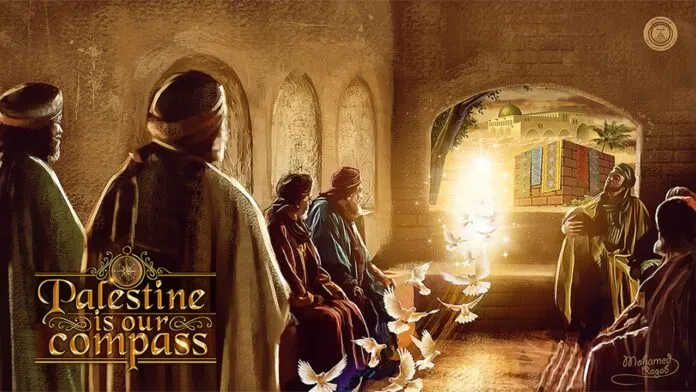
“O you who have believed, be persistently standing firm in justice, witnesses for Allah, even if it be against yourselves, or parents and relatives. Whether one is rich or poor, Allah is more worthy of both. So follow not [personal] inclination, lest you not be just. And if you distort [your testimony] or refuse [to give it], then indeed Allah is ever, with what you do, Acquainted.”
— Surah An-Nisa (4:135)
In this ayah, Allah (SWT) corrects us all when we are tempted to let bias or fear sway our judgement — Allah warns us to be persistent in justice, witnesses for Him, even if it’s against our own parents, children, or wealth. As Ibn Kathir, Al-Qurtubi, and Sayyid Qutb all note: this verse calls us to become moral beacons for truth, especially in the face of global oppression, as we see today in Palestine.
Dear brothers and sisters,
Today we reflect on a pressing issue of our time — the occupation, oppression, and double standards we see around the world, particularly in Palestine. We must ask ourselves: where do we stand in the face of these injustices?
Israel resumed its attacks in Gaza on March 18, shattering a two-month ceasefire after talks with Hamas broke down over the next phase of the agreement.
Since October 7, 2023, Israel’s war in Gaza has killed 50,523 Palestinians and wounded 114,638. At least 1,139 people were killed in Israel during the Hamas-led October 7 attacks and more than 200 taken captive. The Palestinian Central Bureau of Statistics stated that Gaza faces ‘largest orphan crisis’ in modern history.
Palestinian children were dressed in shrouds to cover their new Eid clothes, after Israeli bombing in Gaza killed them on the first day of Eid al-Fitr. Despite this, we see Hungary ending its membership of the International Criminal Court as it staged a red-carpet welcome for the Israeli Prime Minister. This is because the ICC has issued an arrest warrant for Netanyahu on suspicion of committing war crimes in Gaza.
This context is important for us as a week has not passed us since Ramadan and many of us are probably preparing for holiday leave with our families or impending exams for our younger audience.
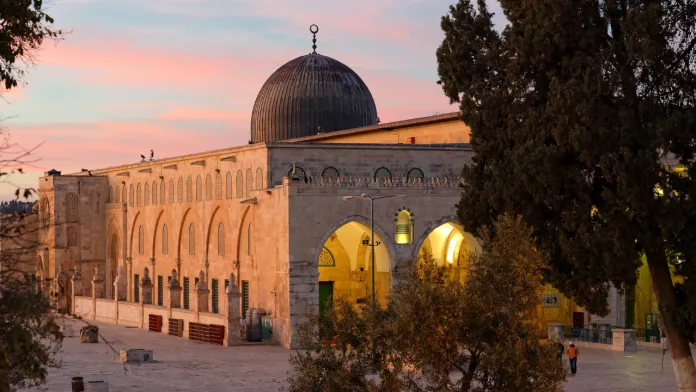
Its also important for us to understand the historical context of Masjid Aqsa and its surrounds so that we can see the cycle of events.
3,200 years ago when Prophet Musa (AS) led Bani Isra’eel out of Egypt it was occupied by a community referred to as Jabbareen – a powerful community who some consider the Malakites. And we know because of their fear, they refused to enter the land, leading Allah (SWT) to punish them with 40 years of wandering in the desert. A Prophet in the following generation, Yusha(AS) leads them to victory after this period and they remain there for more than 3,000 years.
Then, In 70 CE the Romans destroyed the area that includes the current Al-Aqsa compound (Haram al-Sharif) and no masjid existed here for almost 600 years.
2 years ago, I participated in the Palestine Marathon which began from the مسجد عمر Masjid Umar, the only masjid in the Old City of Bethlehem, Palestine. Some years after the passing of the Prophet(SAW), Khalid b. al Waleed was fulfilling the prophecy of Prophecy of the conquest of Jerusalem which had been foretold in the latter years of the Prophet (SAW) life, and so the Muslims surrounded Jerusalem in 637 CE.
The Patriarch Sophronius, the city's Christian leader, agreed to surrender but requested that Caliph Umar receive the city's submission personally. Umar traveled from Madinah to Jerusalem, where he was received well by Sophronius. Demonstrating humility, Umar declined to pray inside the Church of the Holy Sepulchre to prevent future Muslim claims over the church. Instead, he prayed outside, on the eastern steps of the church. To commemorate this event, the Mosque of Omar was later established at that location.
Umar signed a pact (often called the Covenant of Umar) ensuring Christians' rights to their holy sites. To avoid inter-Christian disputes over access, he entrusted a neutral Muslim family with the keykeeping role.
This arrangement has survived centuries, crossing the Crusader period, the Ottoman Khalifate, the British Mandate and the Israeli administration. Till today, early each morning, a member of the Ju’dah family hands the key to a Nuseibeh family member, who then ceremonially unlocks the church door — a powerful daily reminder of co-existence.
After securing Jerusalem, Umar proceeded to Bethlehem. He visited the Church of the Nativity, prayed in its southern aisle, and issued a decree ensuring the church would remain a Christian place of worship. In honor of his visit and actions, the Mosque of Omar in Bethlehem was constructed in 1860 on land donated by the Greek Orthodox Church.
So for 463 years, this remained in the hands of the Muslim Ummah. Then the Crusader occupation took place in 1099 CE and Masjid al Aqsa was converted into a palace and church, while the Dome of the Rock became a Christian shrine and it becomes HQ for the Knights Templar.
For 88 years it remained occupied until in 1187 CE Salahuddin al-Ayyubi (Saladin) reconquered Jerusalem and restored the mosque as a place of Muslim worship. For over 700 years, it remained in the control of the Ayyubids, Mamluks, and Ottoman Empire and much of the structure you see there today remains from then.
Jerusalem falls under British rule after WWI c. 1917 although it remained in Muslim custodianship with specific authority by the Jordanian rule from the 1948 Arab-Israeli war.
What would the Prophet (SAW) say
Some of you may be wondering why this historical overview is being presented in Jumuah and part of the reason was that while I was in Madinah last week, I reviewed the first khutba of the Prophet (SAW) when he arrived in Yathrib. Remember, the context, he was a refugee with no home, little possessions and with a bounty on his head. The 70-odd Muslims who had migrated had been persecuted for almost a decade and his khutba is beautiful when you analyse it. He (SAW):
- Began with hamd (praise and thanks) of Allah(SWT), especially pointing out that misguidance was rampant and the Hour draws imminently closer.
- Those who follow Islam, in true submission to their Lord, will be successful (even though they would be considered needy refugees in the worldly view)
- He (SAW) reminded them to be conscious of Allah(SWT) and remain sincere
- True honour and respect lies in rectifying our relationship with Allah(SWT) privately and publicly
- Then he (SAW) quoted that Allah (SWT) warns us about Himself and He is never unjust
- The fruits of Taqwa are forgiveness and a magnificent reward, brightness of your face, pleasing Allah(SWT) and raising your rank
- Quran teaches you what is right and wrong
- Be good, oppose the enemies of Allah(SWT) and keep on striving – Allah (SWT) is greater than all else and there is no strength or power without Him.
How does this relate to my advice to you?
Who are the those who continue to strive for Allahs sake
Never forsaking their homes, despite them being martyred on Eid day.
Br Naeem was in Masjid Aqsa last week and he had an opportunity to speak to Sheikh Omar Fahmi Abdallah, the Head Imam who narrated how "The government offered me a role to be the Head of Religious Affairs. They offered me an enormous salary, cars, my own security, chauffeurs, a massive home and an easy life if I relocated but I turned it down. They thought I was crazy and said that normal people would do anything for the job. I replied, 'I can't take the job because I refuse to leave Masjid al-Aqsa and its people! I could have 6 times my salary if I wanted but I only want the liberation of al-Aqsa."
When a khatib came to Imam Muhammad al-Nabhan and said that the government were forcing him to say things against the religion – the imam said, "Give up your post and become a shoe cobbler. It is better to live in poverty and loneliness in this world than to be bankrupt in the akhirah."
Visit
MashaAllah, numerous people from Luton and many across the world visitd al Aqsa throughout Ramadan and they communicated the request from the locals. “Nobody asked us for money or handouts – the only thing they said is “Don’t forget al Aqsa. Keep coming and keep us in your dua. Show these people we are not alone.” You have to go – show solidarity.
For those who say you are only supporting the existing system there by spending money in the area, know that you can decide to support the Palestinian businesses out there who have remained resolute and are muraabitoon – on the front line of the community.
And most importantly, the Prophet (SAW) told us, during the time when it was under Roman rule and before the Muslims had control over it –
"ائتوه فصلوا فيه، فإن لم تأتوه وتصلوا فيه، فابعثوا بزيت يُسرج في قناديله."
— Musnad Ahmad (Hadith 27124), graded Hasan (sound)
“Go and pray in it (Masjid Al-Aqsa). And if you cannot go and pray in it, then send oil to be used in its lamps.” While we consider our holiday trips for the year, know the Prophet (SAW) said
لَا تُشَدُّ الرِّحَالُ إِلَّا إِلَى ثَلَاثَةِ مَسَاجِدَ: الْمَسْجِدِ الْحَرَامِ، وَمَسْجِدِي هَذَا، وَالْمَسْجِدِ الْأَقْصَى
— Sahih al-Bukhari (1189), Sahih Muslim (1397)
And if you can’t, at least support
Give in charity to light the lamps, support the residents and feed those who represent us when many may have forsaken them.
Also, withhold from those who support war crimes. I was so pleased to see that in January, Bristol City Council passed a motion calling for divestment from companies linked to Israeli war crimes in Gaza and the arms trade, marking a significant milestone for the Palestine solidarity movement.
Held a day before a ceasefire was announced, the motion urged an immediate and lasting ceasefire to prevent further loss of life and encouraged local government pension funds, which the council does not directly manage, “to develop an ethical investment policy.”
The end of apartheid in South Africa was the result of a combination of sustained internal resistance and external pressure, and international boycotts played a critical role. Domestically, decades of grassroots activism, civil disobedience, and the relentless struggle of groups like the African National Congress (ANC) and leaders such as Nelson Mandela eroded the moral legitimacy of apartheid. However, it was the global anti-apartheid movement, particularly the economic, cultural, academic, and sports boycotts, that significantly isolated the South African regime. Countries imposed sanctions, multinational corporations withdrew investments, and artists, athletes, and universities severed ties — all of which intensified economic pressure and diplomatic isolation.
We must also engage with our own community leaders — our MPs, councillors, and scholars — urging them to take a principled stand.
Raise your voice
Let us raise our voices even when it is uncomfortable. Let us engage with the tools of the time — social media, public forums, petitions, and professional platforms — to speak out, write, and advocate.
Ordinary users around the world, many of them youth activists, have used platforms like Instagram, TikTok, and X to share facts, testimonies, and footage from Gaza and the West Bank.
Co-operate in good
Unite with others who are engaged in the struggle without compromising your own values.
The Centre for Media Monitoring (CfMM), a spin-off org from the MCB, has played a pivotal role in addressing and challenging anti-Palestinian and Islamophobic narratives within UK media. Through meticulous analysis and reporting, CfMM has highlighted biases and advocated for more balanced and accurate representations.
In its report titled 'Media Bias Gaza 2023-24', CfMM critically examined the British media's portrayal of Israel's actions in Gaza following events on October 7. The study uncovered significant biases, notably the disproportionate use of terms like 'atrocities', 'slaughter', and 'massacre' when referring to Israeli victims, while similar language was sparingly used for Palestinian casualties. This imbalance contributed to a skewed narrative that often marginalized Palestinian perspectives.
Conclusion
‘Abdullah ibn 'Amr reported: "When Sulaiman bin Dawud finished building Bait Al-Maqdis, he asked Allah for three things: judgment that was in harmony with His judgment, and he was given that; and he asked Allah for a dominion that no one after him would have, and he was given that; and when he finished building the Masjid, he asked Allah, the Mighty and Sublime, that no one should come to it, intending only to pray there, but he would emerge free of sin as the day his mother bore him." [Sahih of Imam an-Nasa'i]
Raise your voice, but do so with wisdom. Be strategic, not reactionary. Be prophetic in your da’wah, just as our Messenger ﷺ was when he spoke truth to power — not for popularity, but for justice.
May Allah grant victory to the oppressed, wisdom to the advocates, and sincerity to all who work for truth.