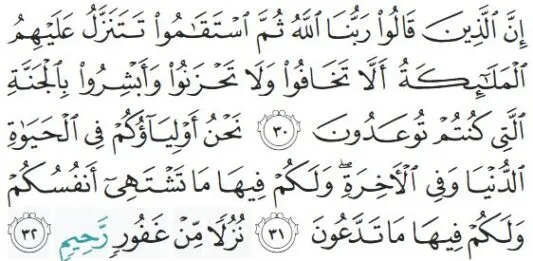
“Surely those who say, “Our Lord is Allah,” and then remain steadfast, the angels descend upon them, ˹saying,˺ “Do not fear, nor grieve. Rather, rejoice in the good news of Paradise, which you have been promised.
We are your supporters in this worldly life and in the Hereafter. There you will have whatever your souls desire, and there you will have whatever you ask for - an accommodation from the All-Forgiving, Most Merciful ˹Lord˺.”” Surah Fussilat (41:30-32)
According to Waki' Ibn Jarrah, this will happen on three occasions, first at the time of death, secondly in the graves, and thirdly on the Day of Resurrection at the time of rising from graves. And Abu Hayyan has opined in Al-Bahr-ul-Muhit that, in fact, angels keep on descending upon Mu'mins (believers) all the time, even in this life, and their effects and blessings are found in the deeds of the believers; but they will be visible on these occasions only, and it is at that time that the voice of angels will be heard.
Umar (RA) has explained “Istiqamah is that you hold on unwaveringly to all the injunctions of Allah - carry out the good deeds and stay away from prohibitions, and do not seek escape-routes like foxes.” (Mazhari).
It is stated in Tafsir Kashshaf that a person's declaration that his Lord is Allah can only be true when he believes from the bottom of his heart that he is being brought up by Allah Almighty in all situations and at every step, that he cannot take even one breath without His mercy, and all this demands that one should be so devoted and steadfast in his ways of worship that neither his heart nor his body should deviate even to a hair's breadth from submission to Him like a slave.
That is the reason that once the Holy Prophet ﷺ was asked by Sayyidna Sufyan Ibn ` Abdullah Thaqafi ؓ to tell him something so comprehensive about Islam that he should not have to ask anybody else afterwards for anything. The Holy Prophet ﷺ said to him:) "Say, ` I have faith in Allah', and then remain steadfast to it."
قُلْ لِي فِي الإِسْلاَمِ قَوْلاً لاَ أَسْأَلُ عَنْهُ أَحَدًا بَعْدَكَ قَالَ رَسُولُ اللَّهِ صَلَّى اللهُ عَلَيْهِ وَسَلَّمَ قُلْ آمَنْتُ بِاللَّهِ فَاسْتَقِمْ
A week from Ramadan, what has continued after Ramadan?
- Sleep: Probably the most noticeble physical change many have experienced. Operating on reduced sleep really was a blessing in Ramadan but sleep has definitely caught many of us up post Ramadan.
- Fasting of Shawwal
- Perhaps a Dua which you have learnt and included in your daily salaah or dhikr
- A bad habit you left - an app you dropped for Ramadan or wasted time
Someone sent me an apt message the other day which asked how much time do we spend in a day praying. If you add all the five prayers together, for the average persian it totals 55 minutes, which if you round it to an hour, means we spend 1 hour out of 24 hours praying - thats 4% of our day. If I was to ask you to increase that to 8 hours, most of us would be in shock. What about 10 hours or 12 hours - impossible?
How long do you spend at work daily? And how difficult is it to put in a few more hours. Not at all? It’s amazing what a mindset change can do to drive motivation.
Isnt it amazing to think that if Allah (SWT) grants you 70 years of your life, you would spend:
24 Years sleeping,
14 Years working,
8 Years in amusement,
6 Years at the dining table,
5 Years travelling,
4 Years in conversation,
3 Years in education,
3 Years reading,
3 Years watching television.
If you pray 5 times a day, you would only be giving Allah 5 months of your life.
What was the training programme of Ramadan?
To understand what should continue, its important to know what the Ramadan training programme was training. As my teacher related to me, the struggle (mujaahadah) of Ramadan aimed to train us to reducte (taqleel) in four areas:
Taqleel-ut-Ta’aam: to reduce eating with fasting
Taqleel-ul-Manaam: to reduce sleeping with qiyaam
Taqleel-ul-Kalaam: to reduce conversation (including on apps), so you speak only when necessary, replacing it with recitation of Qur’an and dhikr
Taqleel-ul-Ikhtilaati Ma’al Anaam: to reduce socialising by increasing time with Allah(SWT) in the masaajid and with itikaaf
And it was easier in Ramadan because Allah(SWT) saved us from our greatest trials:
- Shaytan
- Our nafs: ego and desires, withheld by fasting
- The distraction of others as we sought out good company and spent more time in the masjid
And rather than lamenting how quickly Ramadan passed we should see how we can remain shielded and in higher states of Taqwa. When a friend asked me recently about how to communicate this to his colleagues at work in English, I responded:
- Mindfulness of God ie. When your mind is fully occupied with someone or something, like a person whose parents are unwell
- Fear of disappointing or letting God down, like when you don’t want to upset your parents by disobeying them, even in their absence
- Caution so you don’t step out of acceptable boundaries of Allah, like when we avoid ambiguity with a customer contract and seek to impress them at all opportunities
Shaykh Jaleel Ahmad Akhun whose family emigrated from Hotan, a town in the Xingjian province of China, explained that as one steadily fills their heart with sincere love of God, love of dunya is gradually cast out. Imagine travelling on an airplane journey - while the plane is still on the tarmac, one peers out the window, other planes and the airport terminals look large and imposing. But as the plane takes off and starts its upward climb, those same objects appear smaller and smaller, until they look so tiny and insignificant, and just disappear. Likewise, as we make a serious effort to fill our heart with Allah’s love; as the heart soars higher and higher on the Siraat of guidance to Him, the dunya appears more and more insignificant in its sight; until it diminishes, dwindles, and finally vanishes.
What is istiqamah?
Istiqamah is often translated to mean uprightness, correctness, integrity, soundness, perfection, righteousness, guarding over something constantly (watching over it), steadfastness and doing it correctly making ‘Siraatul Mustaqeem’ the correct, moral path. It comes from the root word قام (qama) meaning ‘to rise’ or ‘to stand upright’ and it’s from this that we derive words like مستقيم(mustaqeem) as in ‘Sirat al-Mustaqeem’ (Straight Path).
For the believer, Istiqamah is a virtue that cannot be done without. It’s a quality that we continually strive to attain although we may fail at times. In this age where fitan (tribulations) have become widespread and open sin is the norm, many people have lost the Istiqamah they once had in them – the strength to stay upon the straight path with firmness has escaped through their fingers.
Imam Ahmad recorded in his Musnad that An-Nawwas bin Sam`an said that the Prophet ﷺ said,
«ضَرَبَ اللهُ مَثَلًا صِرَاطًا مُسْتَقِيمًا، وَعَلَى جَنْبَتَيِ الصِّرَاطِ سُورَانِ فِيهِمَا أَبْوَابٌ مُفَتَّحَةٌ، وَعَلَى الْأَبْوَابِ سُتُورٌ مُرْخَاةٌ، وَعَلَى بَابِ الصِّرَاطِ دَاعٍ يَقُولُ: يَاأَيُّهَا النَّاسُ ادْخُلُوا الصِّرَاطَ جَمِيعًا وَلَا تَعْوَجُّوا، وَدَاعٍ يَدْعُو مِنْ فَوْقِ الصِّرَاطِ، فَإِذَا أَرَادَ الْإِنْسَانُ أَنْ يَفْتَحَ شَيْئًا مِنْ تِلْكَ الْأَبْوَابِ قَالَ:وَيْحَكَ لَا تَفْتَحْهُ فَإِنَّكَ إِنْ فَتَحْتَهُ تَلِجْهُ فَالصِّرَاطُ: الْإِسْلَامُ وَالسُّورَانِ: حُدُودُ اللهِ وَالْأَبْوَابُ الْمُفَتَّحَةُ مَحَارِمُ اللهِ وَذَلِكَ الدَّاعِي عَلَى رَأْسِ الصِّرَاطِ كِتَابُ اللهِ، وَالدَّاعِي مِنْ فَوْقِ الصِّرَاطِ وَاعِظُ اللهِ فِي قَلْبِ كُلِّ مُسْلِمٍ»
(Allah has set an example: a Sirat (straight path) that is surrounded by two walls on both sides, with several open doors within the walls covered with curtains. There is a caller on the gate of the Sirat who heralds, 'O people! Stay on the path and do not deviate from it.' Meanwhile, a caller from above the path is also warning any person who wants to open any of these doors, 'Woe unto you! Do not open it, for if you open it you will pass through.'
The straight path is Islam, the two walls are Allah's set limits, while the doors resemble what Allah has prohibited. The caller on the gate of the Sirat is the Book of Allah, while the caller above the Sirat is Allah's admonishment in the heart of every Muslim.)
The servant needs Allah the Exalted every hour of his life to help him remain firm on the path of guidance and to make him even more firm and persistent on it. The servant does not have the power to benefit or harm himself, except by Allah’s permission. Therefore, Allah directed the servant to invoke Him constantly, so that He provides him with His aid and with firmness and success. Indeed, the happy person is he whom Allah guides to ask of Him.
So what is the Siraat (pathway)?
The adjective straight (mustaqim) tells us that this path is the shortest route to our destination. It also tells us that the road isn’t horizontal but vertical, that every step you take on it raises you upwards. And the higher up you are on it, the more elevated you are above worldly concerns but, at the same time, the more disastrous it will be to fall down.
There are a number of words in Arabic for a pathway e.g. Sabeel, Tareeq, Siraat.
Sabeel is a small passageway, which perhaps has never been trodden. You will need to create your own pathway and there can be many of these potential routes. Hence the term “fee sabeelillah” when mentioned in the Qur’an requires courage, is the lesser trodden path and there are many ways to contribute e.g. spend money, time, effort etc. There are several paths such as speaking truth to power, striving against your desires and even when you are in process of submerging your anger or forcing yourself to love someone you hate for the sake of Allah.
Tareeq refers to an alleyway which could be flat or mountainous.
Siraat however eludes to a massive, huge, level, flat, highway which has no narrowness, bumps or crookedness. In the Qur’an its only referred to as a single path as there is only One.
The Sirat on the Day of Qiyamah is different to those in this world - it will take 3000 years to cross, it will be thinner than a hair strand and sharper than a blade. The only thing that will expand the traverse is the Noor (light) we earned in this dunya from all our ibadah – such as the light gained from wudhu; the light from reciting Qur’an; the light from making salah; the light from helping others; the light from doing zikr; the light from giving charity; the light from showing hayah and so on. – If a person has too much light on the Day of Qiyamah, he/she will cross the Sirat quicker than a blink of an eye. Even the hell-fire will say “hurry up and cross, your light is putting out my flames”.
In relation this, Imam Ghazali also stated that being steadfast on the straight path in this world is as difficult as being steadfast on the path over the Hellfire.
5 ways to develop steadfastness
1. Have certainty in Allah’s promise
All of your previous sins were forgiven - get into that mindset. Like a brand new phone or new car, how careful are you ensuring it doesn't get a scratch on it while its new?
Regarding this, I often think about the issue of sutrah. The hadith states “If the one who passes in front of a person who is praying knew what (a burden of sin) he bears, it would be better for him to stand for forty rather than pass in front of him.” Abu’l-Nadar – one of the narrators – said: I do not know whether he said forty days or months or years. [al-Bukhaari, 510; Muslim, 507] Sometimes someone places his phone / glasses on the floor in front of him, and how does he respond when someone absentmindedly crosses his path with the risk of stepping on his valuables, vs when someone crosses his conversation with Allah(SWT)?
Similarly, we need to consider this a new slate and take care not to spoilt it, like our most beloved possessions in the Dunya.
2. Ask for firmness of your heart
Umm Salamah reported: I said, “O Messenger of Allah, how often you supplicate saying: O Turner of the hearts, keep my heart firm upon Your religion.” The Messenger of Allah, peace and blessings be upon him, said, “O Umm Salamah, there is no human but that his heart is between the fingers of Allah. Whoever He wills is made steadfast and whoever He wills is deviated.” Mu’adh recited the verse, “Our Lord, do not let our hearts deviate after you have guided us.” (3:8) [Sunan al-Tirmidhī 3522]
مَا أَكْثَرَ دُعَاءَكَ يَا مُقَلِّبَ الْقُلُوبِ ثَبِّتْ قَلْبِي عَلَى دِينِكَ قَالَ رَسُولُ اللَّهِ صَلَّى اللَّهُ عَلَيْهِ وَسَلَّمَ يَا أُمَّ سَلَمَةَ إِنَّهُ لَيْسَ آدَمِيٌّ إِلَّا وَقَلْبُهُ بَيْنَ أُصْبُعَيْنِ مِنْ أَصَابِعِ اللَّهِ فَمَنْ شَاءَ أَقَامَ وَمَنْ شَاءَ أَزَاغَ فَتَلَا مُعَاذٌ رَبَّنَا لَا تُزِغْ قُلُوبَنَا بَعْدَ إِذْ هَدَيْتَنَا
Ibn al-Qayyim mentions that some knowledgeable people would say, “Be the companion of Istiqamah and not the seeker of respect and nobility [amongst the people], because your soul seeks this respect and nobility while Allah has called it to seek Istiqamah.”
Keep asking for 6 months
Imam Ibn Rajab al-Hanbali (rh) stated that the sahabah would supplicate to Allah Ta`ala for six months to allow them to reach Ramadhan. Then, they would supplicate to Him another six months to accept it from them. Yahya bin Abi Kathir states: it was from their supplication:
اللهم سلِّمني إلى رمضان، اللهم سلم لي رمضان، وتَسلَّمه منّي متقبَّلا
Allahumma sallimnee ilaa Ramadhan, Allahumma sallim lee Ramadhan, wa tasallamhu minnee mutaqabbalaa O Allah, commit me to Ramadan. Oh Allah commit Ramadan for me. And receive it from me with acceptance.
Surely the one asking for 6 months after Ramadan, will be diligent about their actions during this period. So don’t forget this blessed month.
3. Have a game plan - set realistic goals
Treat your Ramadan goals as seriously as your work, study or health goals. Commit to things you want to keep up. Write them down. Monitor them. Make them realistic and small.
Narrated `Aisha: Allah's Messenger (ﷺ) said, "Do good deeds properly, sincerely and moderately and know that your deeds will not make you enter Paradise, and that the most beloved deed to Allah is the most regular and constant even if it were little." [Bukhari 6464]
4. Figure out your strengths and amplify them
What did you enjoy the most? Build on that. Ibn ul Qayyim said the greatest benefit of virtue (apart from the reward) is that it brings closer to the next virtue and the greatest setback to evil (apart from the punishment) is that it makes you prone and susceptible to more wrong. The Arabic poet has said your gaze roams, its a smile, then theres a smile, then its exchange of phone numbers, and then its infidelity and then a marriage breaks and then you're in regret and it erodes the whole society
Remember that Abdullah ibn Masood (ra) said, “It was difficult for us to memorise the words of the Qur’ān but easy for us to act by them. After us will be people for whom it is easy to memorise the Qur’ān, but hard to act by it.” (Tafsir Qurtubi)
5. Seek forgiveness often
By Allah’s Mercy, we are not required to have perfect istiqamah. The way to attain istiqamah is to live according to the Qur’an to the best of our ability.
Whenever we fall short of that, we should immediately repent to Allah(SWT) seeking His pardon and forgiveness.
Rasoolullah(SAW) said “O people, you will not be able to handle, or you will not do, all that you have been commanded to, but aim to achieve righteousness and receive glad tidings (that Allah will reward you for it)”.
“So keep your duty to Allah and fear Him as much as you can: and listen and obey, and spend in charity. That is better for yourselves” (64:16)
“Say: I am but a human being like you. It is revealed to me by inspiration, that your God is One God. So stand firm and true to Him, and ask for His Forgiveness: and woe to those who join gods with Allah” (41:6)
Ibn Rajab (rh) explained in his Jami’ al Uloom wal Hukam, that this verse is a sign that everyone will somehow fall short in istiqamah. That is why immediately after being commanded to be steadfast, we are ordered to seek forgiveness.
So find those small, good acts which you can continue in your life as now is the time for change. Shaytan has no concerns for our noble intentions so as long as they remain for tomorrow, not today.
May Allah(SWT) help us all in our constant struggle to obey Him to the best of our abilities, and may He accept us with our shortcomings and shower us with His abundant Mercy and Forgiveness, Aameen.